
November 2026 · Haircuts
Curly Butterfly Cut: The Butterfly, Translated for Curls
The butterfly cut was designed on straight hair: short layers framing the face, length protected behind. Curls can have the same wings. They just cannot have the same blueprint.
By Cris, licensed cosmetologist and owner of CRIS HAIR
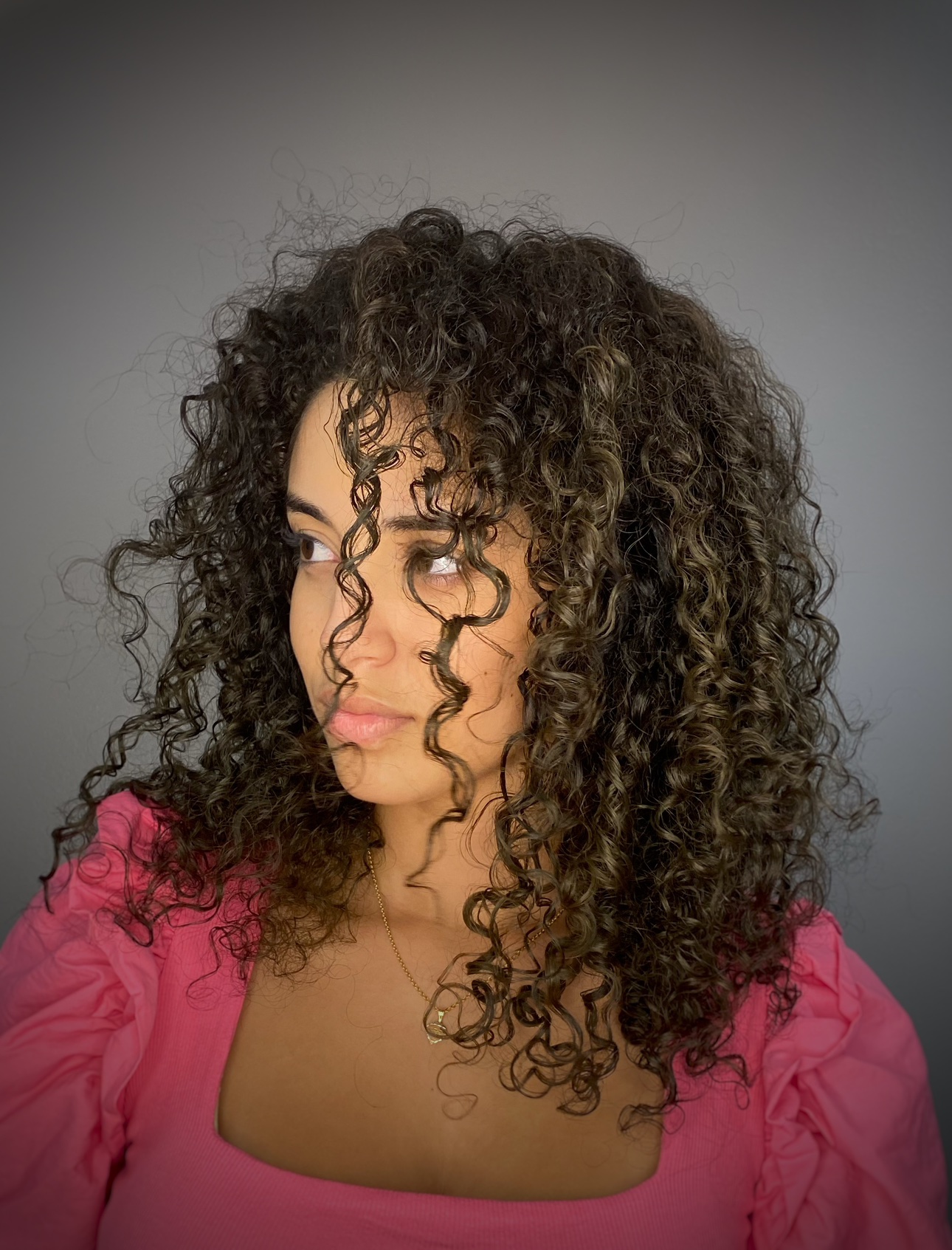
Every curly client who brings me a butterfly cut photo brings me a picture of straight hair, and my first job is translation. The desire underneath the photo is real and reasonable: movement around the face, volume on top, and the length she spent years growing left alone. All of that is achievable on curls. None of it arrives by copying the straight-hair diagram onto a head where every strand is a spring.
Why the straight blueprint breaks on curls
Three things change everything. Shrinkage: a curl cut at chin length wet can live at cheekbone length dry, so layers copied by eye from a straight photo land inches higher than intended. Volume: straight hair falls where it is placed; curly hair expands outward, so the short face-framing layers that look delicate on straight hair can become a triangle with a face in it. And pattern: most curly heads carry more than one curl pattern, looser at the front, tighter underneath, so a layer that behaves beautifully in one zone misbehaves in the next. The cut is not wrong. The map is for a different territory.
How I translate it
The architecture survives; the measurements change. The short layers still frame the face, but I cut them longer than the photo suggests, because shrinkage will finish the job the scissors should not. The framing is carved curl by curl in the front, where the pattern is most visible, instead of sliced in straight sections. The top layers keep their lift, but the weight is distributed so the shape reads round and intentional rather than wide at the bottom. And the length behind, the part every butterfly client is protecting, stays protected: the whole point of this cut is that you leave with the same length you grew, wearing a completely different shape. Where the straight butterfly is built with the comb and the blow-dryer, the curly one is built with the dry shape in front of me, because dry is how the hair actually lives.
Who it flatters, and who I talk out of it
It flatters medium to long curls with enough density to share: the layers need material to work with. Wavy hair and looser curls take the softest, most romantic version. Tighter curls take a bolder one, with more air between the layers. I talk two clients out of it honestly. The very fine, low-density curly client, whose layers would expose scalp and string out the ends; for her, a gentler shaping keeps the fullness illusion intact. And the client in the middle of a transition, growing out relaxed or heat-damaged lengths: her two textures shrink at different rates, and a precision-layered cut drawn on that moving canvas will not sit evenly until the transition is further along. For her we shape simply now and butterfly later.
The day after, and every day after
A butterfly on curls is a friendly cut to live with, because the shape is in the haircut, not in the styling. Refresh is water and a little product scrunched back into the front layers, the ones doing the framing work. The cut grows out gracefully for the first months, since the layers were placed with air in them; when the face frame starts merging into the length, usually around the third or fourth month, that is the maintenance visit, a reshaping rather than a new cut. My one warning: the front layers are shorter, so heat styling them daily with a flat iron fights the design. This cut wants to be worn curly. That is not a limitation. That is the entire idea.
Frequently asked questions
Will it shrink my hair a lot?
The shape will look shorter around the face, because that is the design, but the length behind stays. I cut the framing layers accounting for your shrinkage, which is why the front is cut longer than the photo you brought.
Do I lose my length?
No. Keeping the length is the definition of the cut. What changes is the distribution: shorter, lighter layers on top and around the face, full length preserved at the back.
How long does the shape last?
Most curly clients reshape every three to four months, when the face-framing layers grow down into the length. Between visits, the cut grows out softly rather than collapsing.
Does it work on wavy hair?
Yes, beautifully, in its softest version. Waves take the framing and the lift with less shrinkage to manage, so the translation is even closer to the original photo.
Can I get it while transitioning?
I usually advise waiting until the two textures are closer in behavior, or shaping conservatively in the meantime. A layered design needs a predictable canvas, and the strand-by-strand consultation will tell us honestly where your hair is in that process.
Wings, Translated for Your Curls
The photo you saved is not off limits because your hair curls. It just needs a translation, cut curl by curl around your pattern, with your length protected. That translation happens in the chair, one client at a time.
Book a Consultation