
October 2026 · From the Chair
The Chair Is Built on Trust
Why women tell their hairdresser things they tell no one else
By Cris, licensed cosmetologist and owner of CRIS HAIR
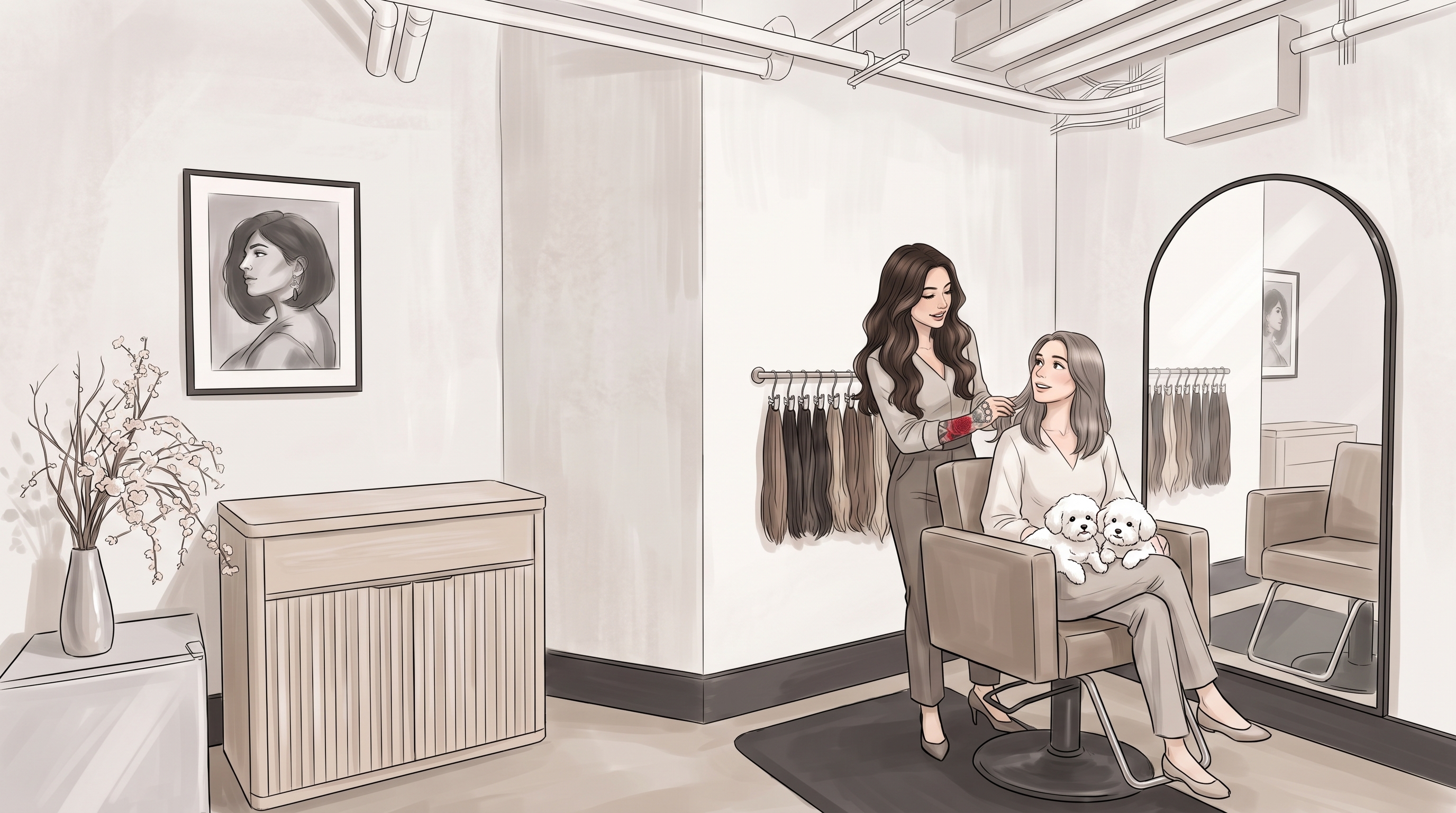
One of the most important things in my work has never been just the hair. It is the relationship I build with the woman in my chair.
I talk with my clients without rushing. I listen, I ask questions, and I try to understand the why behind what she is asking for. When a client wants a transformation, there is always a reason. She is going through something. She wants to feel different, or she wants to feel like herself again. Sometimes the decision has been growing in her for months. Sometimes it is a hard week, hormones and all, and everything feels urgent at once. Those are two very different chairs, and I need to know which one she is sitting in before I pick up my scissors or mix a color.
Because hair is never just hair. It is tied to how a woman sees herself, to her confidence and her self-esteem. A transformation can be the beginning of a new chapter. It can also be an impulse she might regret in the morning. Part of my job is hearing the difference.
My clients open up to me. We talk, and I share things too. It is a real conversation. But if I am honest, I spend most of our time together listening. I listen a lot. I also read and keep learning about many different subjects, because my clients bring their whole lives into this studio, and I want to truly understand what they are telling me, not just nod along.
When something serious comes up, something that calls for a doctor or another health professional, I say so, and I encourage her to get that help. That is part of taking her seriously. And maybe that is why this work means so much to me. I consider my clients my friends. Not in a casual way. In the way that grows from years of appointments, stories, laughter, hard days and new beginnings, all in the same chair.
So when I read a recent study about hairdressers and trust, I was not surprised. I felt seen.
Maybe you know this moment from the other side of the chair. You sit down, the cape goes on, and for the first time in weeks, nobody needs anything from you. Your phone is in your bag. Your hands are still. And somewhere between the roots and the ends, the things you have been holding in start to come up, quietly, a little at a time. If you have ever left a salon feeling lighter than a haircut alone can explain, you know exactly what I mean.
Key takeaways
- In the Bluemind Foundation Trust Study, 30 percent of clients surveyed said their hairdresser is the first person they turn to when facing a difficulty.
- Among clients interviewed in depth, 89 percent said they tell their hairdresser things they tell no one else.
- Trust like this comes with responsibility, and with clear limits. Listening is part of the care. It is not therapy.
A recent study put numbers to it
The Trust Study, released by the Bluemind Foundation in October 2026, surveyed 576 women in Togo, 205 clients and 371 hairdressers, in Lomé, Kara, Sokodé and Dapaong. When facing a difficulty, 30 percent of the clients said they turn first to their hairdresser, second only to family at 41 percent, and well ahead of friends at 11 percent. Fewer than 1 percent named a health professional.
The deeper interviews say even more. Among the clients interviewed in depth, 89 percent said they tell their hairdresser things they say nowhere else. And every hairdresser interviewed in depth, 100 percent, said she had noticed a client was struggling before the client put it into words. It is an exploratory study of one country, so it does not prove the same pattern holds everywhere. Still, anyone who has sat in a salon chair, on either side of it, will recognize what it describes.
Why the chair feels safe
The study points to simple ingredients. There is repeated contact over time, because you see your hairdresser again and again over the years. There is discretion, because what is said in the chair stays in the chair. There is no judgment. And there is a helpful distance. Your hairdresser is close, but not too close. She is not family, she is not in your daily circle, and that small distance makes honesty easier.
There is also the rhythm of the appointment itself. An hour or two where someone is paying full attention to you, and you do not have to perform, explain yourself, or be strong for anyone. Very few moments in adult life are built like that.
What changes when the studio is private
This is exactly why I built CRIS HAIR the way I did. My studio in Malden works with one client at a time. When you are in my chair, there is no one in the next chair listening, no conversation crossing over yours, and no rush because someone else is waiting in the room.
That privacy is not decoration. It is the structure of the appointment. A private room changes what people feel free to say, and even what they feel free to feel. Some clients talk the whole time. Some barely speak, and rest instead. Both are fine here. The space is yours while you are in it, and that is what "A Private Hair Experience" has always meant to me.
Picture it for a moment. The door closes behind you. The studio is quiet. It is just you and me, something to drink beside you, no audience and no clock watching you. Whatever you carried in with you that day, heavy or light, there is room for it here.
Listening has limits, and I respect them
I am a licensed cosmetologist, not a therapist, and the study is clear on this point too: its goal is not to turn hairdressers into health professionals. Since 2021, the foundation's Heal by Hair program has trained hairdressers to listen without judgment, to recognize signs of distress, and to point women toward professional support when something serious comes up. In the study, 99 percent of clients said they would accept, or at least consider, that kind of referral coming from their hairdresser.
Listening with care is part of my work. Knowing when a conversation needs a professional is also part of it. I am not here to rescue anyone. I am here to do beautiful hair, and to be a trustworthy human being while I do it.
From Togo to Malden
Togo and Massachusetts are far apart, and the study does not claim its findings apply everywhere. But trust is not local. It is built the same way in any language: showing up, paying attention, keeping what you hear, and knowing the limits of your role.
So picture your next appointment feeling like that: unhurried, private, and fully yours. If that is the kind of salon experience you have been looking for, I would love to welcome you. You can book your appointment here, and read more about the studio and how I work.
Sources
- Bluemind Foundation, Trust Study 2026, released October 2026 ahead of World Mental Health Day. Evidence and reports: bluemindfoundation.org/system/evidence
- "In Togo, women turn to their hairdressers long before health professionals, new study finds," Soko Directory, October 2026: read the article
One Client. One Chair. One Conversation.
A private studio in Malden, where your appointment is entirely yours.
Book Appointment